

Groundwater Funding
This page provides the most updated information for the 2026 proposed fees. (Click here for a copy of the April 2026 funding webpage)
Funding Tehama’s Groundwater: What it means for you
Summary:
- ~$19M in State grants since 2016; expiring in 2026.
- A local fee is being proposed. This page explains what we know and what’s still being determined.
- NOTE: These fees have not been formally adopted. The District Board of Directors will consider approving them at the public hearing on July 20, 2026. You will have the right to comment and appeal.
- NEW: The final Fee Study is available.
- NEW: A Fee Estimator Tool is available based on the proposed 2026 (note: this is not a bill or official fee calculator)
Key Links
New: 2026 Fee Report | Fees FAQ | Fee Estimator Tool
Tehama Resources: Tehama GSA | Tehama GSPs | Well Registration | Round 2 Grant Updates
Other Resources: State SGMA Site | SGMA Portal | State Intervention | Other factsheets
Background
Groundwater is essential for supporting our homes, farms, and economy.
Tehama County groundwater basins are experiencing moderate overdraft in some areas, with documented declines in groundwater levels, particularly during the 2020-2022 drought, which caused some domestic wells to go dry. The situation is serious but manageable if we act now.
The State requires Groundwater Sustainability Agencies (GSAs) to create and update annually detailed plans on how we are working towards groundwater sustainability. For over a decade, the State has paid for this work, but that funding has run out [Learn more about the current grant.] Tehama County must now self-fund the agency, and we are asking groundwater users in the subbasins to help protect our shared natural resource. The District has existed within the County for decades but does not have fees or a budget for this new unfunded mandate from the State.
The State requires that the District fund this work, and fees are part of that requirement. There are two fees being put in place, one (Admin) to self-fund SGMA compliance and another (PMA) to help fix groundwater related issues such as overdraft within Tehama County. SGMA is State mandated and if local agencies are not compliant, they are subject to State intervention (see here for more information: https://www.waterboards.ca.gov/sgma/reporting_and_fees.html). There are currently two basins in California being intervened upon.
What happens without local funding? State Intervention
If the county fails to establish funding for sustainable groundwater management, the State Water Resources Control Board can take over. [Learn more]

The consequences of State Intervention are significant:
- Much Higher Fees: State fees are typically 5–10× higher than locally designed fees.
- $0 Goes Back Locally: Every dollar collected goes to State administration. None returns to fund local support like recharge projects, water efficiency, or dry well programs.
- Loss of Local Control: Management decisions are made by the State not the locals who understand Tehama’s needs.
- Stricter Rules: State management is more rigid with less flexibility to adapt to Tehama’s specific conditions.
The purpose of developing a local fee is to prevent this outcome
and keep decisions and program dollars in Tehama County.
How much will I have to pay?
There are five categories of groundwater users; each category is assigned a different assumed volume used. The cost per acre-foot remains the same across all user categories. There is an additional PMA fee for irrigated agricultural users in the overdrafted subbasins (Corning, Red Bluff and Los Molinos) to cover projects that address overdraft. For each parcel being charged there is a fee of $1.99 to cover the cost of putting the charge on the Tax Bill. (Follow the link to access an unofficial fee estimator tool based on the proposed fees.) (See below for calculation walk-throughs and examples.)
It is the number of homes x 0.75 x $2.70, no matter what basin it is in.
So for a lot with two houses: 2(homes) x 0.75(acre-feet) x $2.70(per acre-foot) = $4.05 + $1.99 = $6.04 per year
It is number of homes x 1.25 x $2.70
So for a lot with two houses: 1.25(acre-feet) x 2(homes) x $2.70(per acre-foot) = $6.75 + $1.99 = $8.74 per year
It is number of acres x 3.64 x $2.70
So for a 2 acre lot with a commercial building: 2(acres) x 3.64(acre-feet) x $2.70(per acre foot) = $19.66 + $1.99 = $21.65 per year
Use the number from the chart above for your applied water use and multiply it by the number of planted acres on the parcel then by the fee ($2.70/acre-foot).
So for a parcel with 100 acres of prunes:
100(acres) x 3.3(acre-feet/acre) x $2.70(per acre-foot) = $891 + $1.99 = $892.99 per year
Use the number from the chart above for your applied water use and multiply it by the number of planted acres on the parcel then by the fee ($4.70/acre-foot). This includes $2.70 for ADMIN fee and $2.00 for PMA fee.
So for a parcel with 100 acres of prunes::
100(acres) x 3.3(acre-feet/acre) x $4.70(per acre-foot) = $1,551 + $1.99 = $1,552.99 per year
How are fees and costs calculated?
The estimated fees were calculated by:
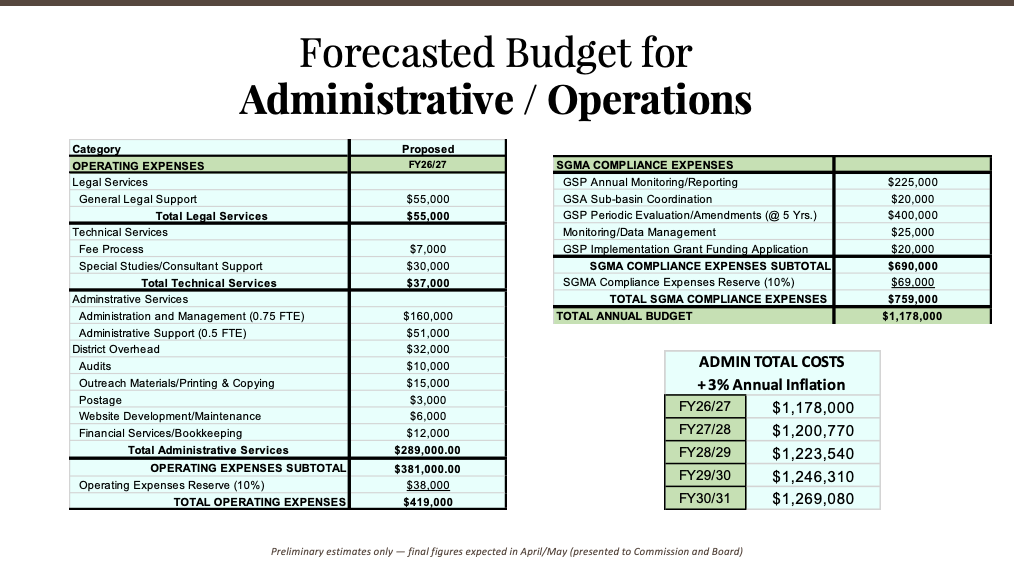
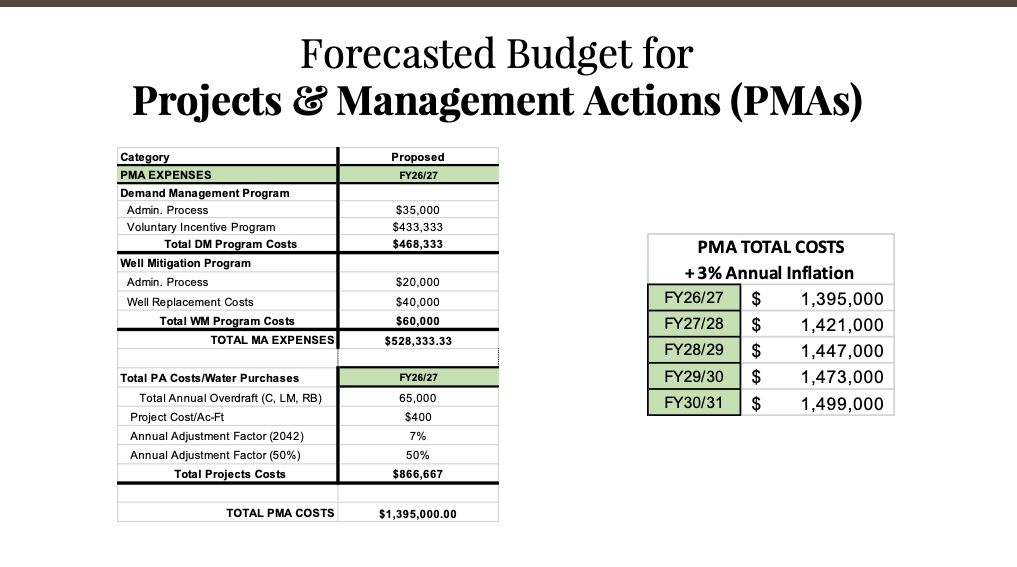
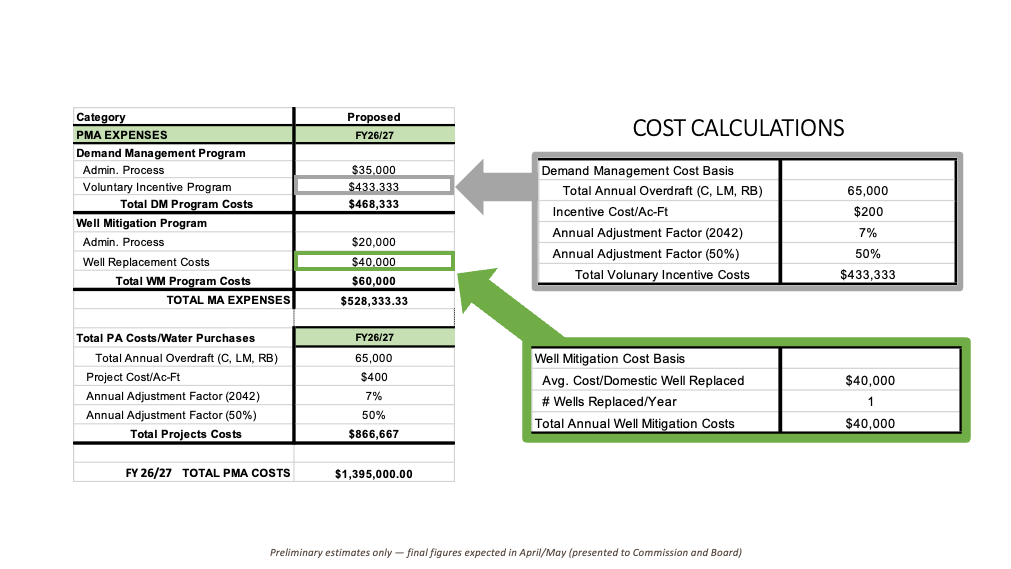
First, estimating the costs for the District to manage groundwater: Administrative/Operations + Projects & Management Actions (see imaged of forecasted budget estimates below)
Then, divide the costs by the fee approach
What are the estimated costs?
How have these options evolved?
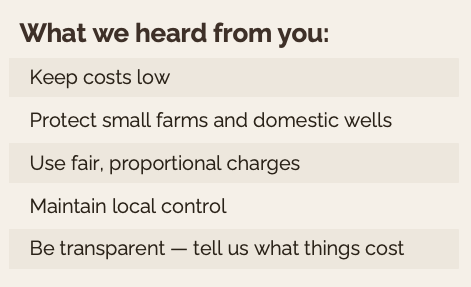
What has your input shaped?
- 110+ Demand management and funding community survey responses
- Stakeholder advisory working group meetings
- Regular public comment at Commission and Board meetings
- Public workshops in December 2025 and April 2026
- Direct outreach to agricultural operators, domestic well owners, and ranchers
What's Next?
- Final well registration due June 30, 2026 [Learn more]
- Public hearing for proposed fee adoption: July 20, 2026
- If adopted, all affected parties will receive a written notice explaining their fee estimate and how to appeal.
Stay Informed. Stay Involved.
Join the email list for updates. Register your well to protect the accuracy of your fee estimate.